Customer decisioning should be one of the most powerful levers for improving Customer Experience. But most organizations still treat it like a 2005 project. And that’s where everything goes sideways. Over indexing on data and analytics, machine learning models and turning customer decisioning to an IT-led project.
Customer experience (CX) is shaped by decisions. Every interaction, message, offer, and response a customer receives is the outcome of a decision made by a system, a process, or a person. When CX improves, it is because the quality of those decisions improves. When it declines, the opposite is true.
Let’s pause for a reality check. According to Forrester’s 2025 Asia Pacific Customer Experience Index, the results for Australia are stark: 58% of brands didn’t move the needle at all, and 37% actually got worse. And Australia is not an outlier. Other parts of the world are not doing any better, in fact in many cases the results are worse. This decline has happened despite years of investment in personalization, journey orchestration, data platforms, and AI. For the second year in a row, CX has moved backwards.
This is the context for any serious discussion about customer decisioning. The gap between CX ambition and CX reality is driven by how decisions are designed, implemented, and governed. Over time, a set of assumptions has become accepted practice, shaping CX architectures and operating models.
The following eleven myths expose the most common misconceptions in customer decisioning that continue to hold CX back.
1. The Data Myth
Most customer decisioning initiatives start with data problem, thinking about data infrastructure, CDPs and how data is collected and managed. The assumption is that if enough customer data, attributes, events, scores, dashboards, and pipelines are assembled, better decisions will naturally emerge. This leads to large analytical records, heavy preprocessing, and complex metadata layers built before a single decision is clearly defined.
In practice, decisions do not improve because more or better data exists. They improve when the decision itself is explicitly modeled. When decisions are explicitly modeled, they define what data is needed, when it is needed, and at what level of precision. Data supports decisions, not the other way around.
2. The Journey Myth
Customer experience (CX) is often treated as a journey design problem. Teams map stages, touchpoints, and flows, assuming that orchestrating the journey will result in better engagement. Decisions are then added as small steps inside the journey, usually late in the design process.
Journeys do not make decisions. Decisions shape journeys. Every interaction is the result of a decision made in a specific context. Without modeling those decisions explicitly, journey orchestration becomes reactive choreography about signals, data and systems. Experience quality depends on decision quality at each moment that are part of a continuum of decision-making, not on reacting to customer signals in a journey orchestration execution.
A customer's journey does not end at the engagement layer. As they continue their relationship with the organisation through service, hardship, claims, or remediation, the next best action must follow them there too.
3. NBA is a MarTech and Marketing Operations Tool
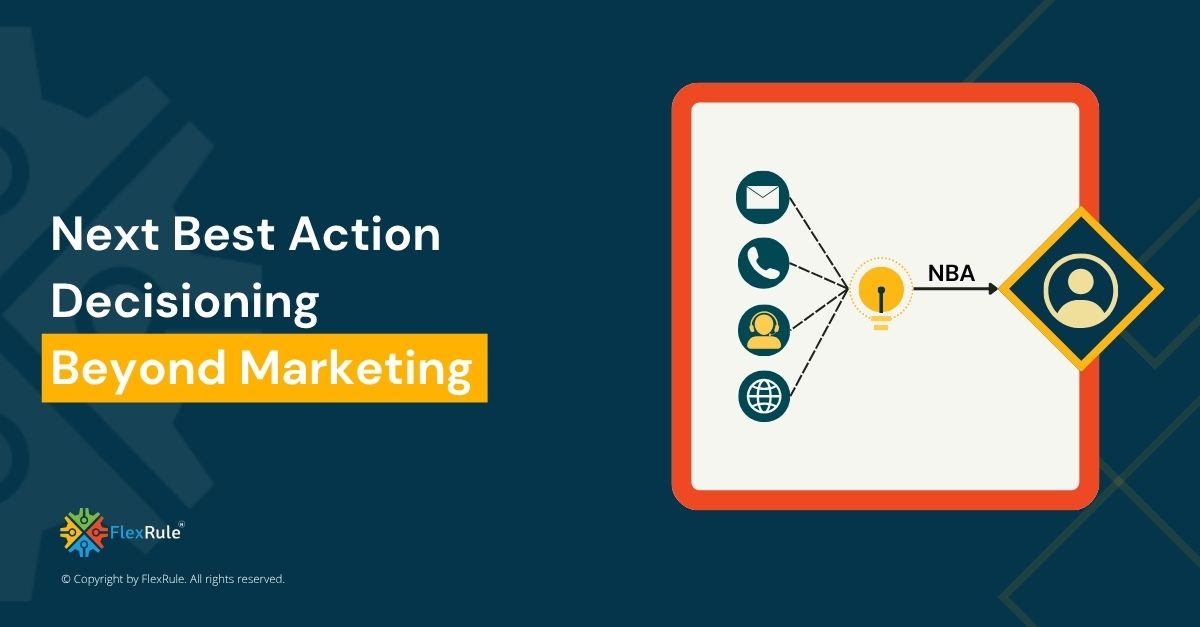
Next Best Action originated in marketing. The major CRM and campaign platforms built it into their stacks and it became associated with offers, conversion, and 1:1 personalisation at the engagement layer. That work is real and NBA does it well.
But the assumption that NBA stops at the engagement layer is where regulated industries get stuck.
The most consequential next best actions are not marketing offers. They are hardship assessments, claims routing decisions, collections holds, vulnerability protocols, fraud responses, and customer remediation pathways. Each is contextual, situation-aware, and real-time. Each also carries regulatory obligation, requires an audit trail, and must be explainable when the regulator asks why.
Marketing NBA was not designed for that. Organisations that treat NBA as a marketing tool leave their most consequential decisions ungoverned. Those decisions fall to agent judgment, static scripts, and after-the-fact compliance reviews. That is where complaints originate. Where remediation programmes are triggered. Where consent orders are written.
NBA is not a marketing tool. It is the framework for every consequential customer-facing decision an organisation makes.
Book a Custom Demo
4. The Strategy Myth
Organizations spend significant time in workshops, alignment sessions, and strategy meetings discussing outcomes, KPIs, and customer intent. The belief is that clearer strategy discussions will translate into better operational outcomes once systems are aligned.
Strategy does not execute itself and alignment does not come from thin air. Unless strategic intent is translated into decision frames and from there to executable decision models based on open standard, it remains abstract and alignment will not happen. Better outcomes come from improving how decisions are defined, evaluated, and governed at runtime based on explicitly modeled decisions, not from repeated alignment discussions.
5. The Model Myth
Predictive models are frequently treated as decision models in the customer decisioning space. Propensity scores, churn predictions, value scores, and rankings are used as if they directly answer the question of what should happen next. Rules and in conjunction with predictive models sitting inside an orchestration are often referred to as models.
Decision model is a specific type of modeling that is not about rules, data and processes. It uses Decision Model and Notation (DMN) that is a common language that bridges the gap between strategy and execution. Without it, decisioning is just reactive and ad-hoc combining of rules, data and scores in a data and IT-led project.
6. The Next Best Action Myth
Next Best Action is often implemented as a ranked list or score-based selection from a catalogue of actions. Filtering, contact policy and eligibility rules, and scoring pipelines narrow down options until one or two actions are chosen from hundreds of choices from the catalogue.
Next Best Action is not a ranking problem. It is the outcome of a decision. The question is not “which action scores highest” but “what is the best action to take now, given objectives, constraints, and context”. With leveraging the Decision-Centric Approach the NBAs become a natural emergence of an explicitly modeled decision, not a post-processing of rules and data to force a proposition.
7. The Business Rules Myth
Traditional implementations assume that decisioning is primarily about business rules executed by orchestration on data. As complexity grows, more eligibility rules, contact policy rules, prioritization rules, and arbitration logic are added to compensate.
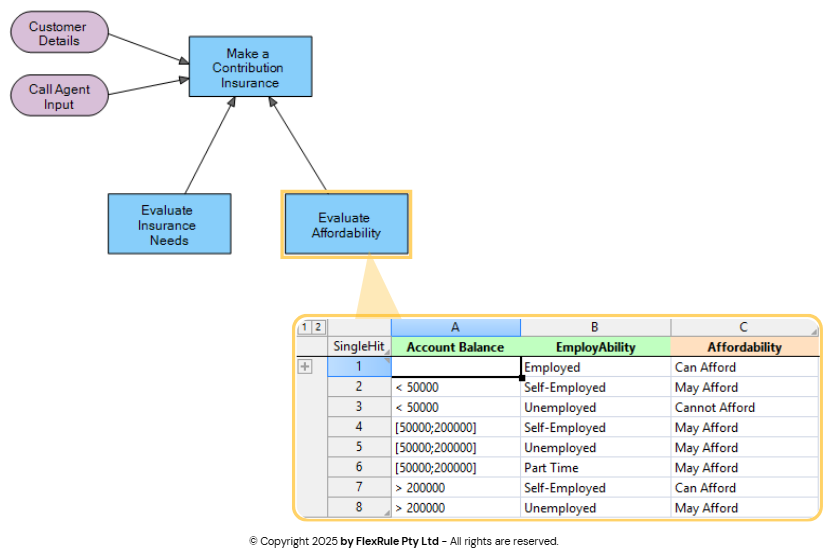
Rules are not decisions. They are components of decisions. When rules are layered without an explicit decision structure, systems become fragile, hard to govern, and difficult to evolve. Decisions are outcome-driven structures specifying evaluation logic, and intent, with rules playing a supporting role.
8. The Real-Time Myth
Real-time decisioning is often equated with real-time data ingestion. Streaming platforms and low-latency data access and pipelines are introduced with the expectation that faster data automatically produces smarter decisions. Customer Analytic Record or CAR in short is the result of this mindset.
Speed alone does not create intelligence. A real-time decision is one that is evaluated at the moment of need, using decision-relevant context. Without an explicit decision model, real-time data simply is just a quick data access layer without defined intent to deliver an outcome.
9. The Governance Myth
Governance is frequently treated as an afterthought. Documentation, approval workflows, or offline reviews. The logic (rules, orchestration, data etc.) is implemented first, and governance is added later as a control mechanism.
In reality, decision governance must be operationalized. Decisions need to be explainable, traceable, versioned, and measurable at runtime and explicitly modeled at design time. When decisions are organizational assets, governance becomes intrinsic to how decisions are designed, evolved, and executed, rather than an afterthought.
10. The Architecture Myth
There is a belief that connecting data, rules, and models into a central engine automatically produces intelligent decisioning, which is often referred to as the “brain”. As a result, architectures grow more complex, tightly coupled, and opaque.
Intelligence does not come from architecture diagrams in customer decisioning by itself, with centralized decision engine. You need an architecture that puts business decisions at the center of marketing operations and customer decisioning.

It means to make business decisions first-class citizens by modeling them explicitly and operationalizing across channels. When decisions are explicitly modeled, architecture becomes simpler, more modular, and more adaptable because every component serves a clear decision purpose. It’s more like a distributed, living nervous system than a cartelized brain.
11. The Agentic AI Myth
There is a growing belief that Agentic AI will solve customer decisioning by itself. The assumption is that autonomous agents, equipped with LLMs, tools, and memory, can observe signals, reason about intent, and take actions without the need for explicit decision models, governance, or structure. In this view, agency replaces decisioning.
Agentic systems do not remove the need for decisions. They amplify it. Without explicitly modeled decisions, agents operate on implicit logic, hidden heuristics, and emergent behavior that is difficult to explain, govern, or align with business objectives. Agency without decision structure simply shifts decisioning from explicit, governed models producing consistent outcomes into opaque runtime behavior, creating inconsistent outcomes and adding new risks rather than solving the old ones.
See how FlexRule's NBA can enhance your customer decisioning.
Final Thought
Customer experience does not improve by accident and should not stop at the engagement layer. It improves when the decisions that drive it improve. The eleven myths outlined here all share the same root problem: decisions are treated as side effects of data, journeys, rules, models, or technology, rather than as the core design element.
The Decision-Centric Approach® addresses this directly. It makes decisions the first-class citizens of organizations by treating them as organizational assets, not hidden logic. Decisions are explicitly modeled, making intent, logic, constraints, and trade-offs clear. They are proactively operationalized, so they can be executed, governed, measured, and evolved over time.
When decisions are designed this way and move beyond marketing operations, data becomes purposeful, context becomes relevant, models become inputs, rules become components, and AI becomes an accelerator rather than a risk. Most importantly, customer experience stops being reactive and starts improving because the decisions shaping it are finally designed to influence both customer engagement and business operations together.
Read More

Last updated August 31st, 2026 at 03:43 pm Published December 15th, 2025 at 10:25 am