
You Don’t Have an AI or Data Problem.
You Have a Decision Problem.
Most enterprises invest heavily in data platforms and AI models.
But decisions are still:
- Embedded in application code
- Spread across services
- Influenced by models without clear boundaries
- Modified without traceable ownership
- Inside dashboard and report
Data is managed. Models are monitored.
But the decision itself is not governed so outcomes are not controlled.
And that is where risk, inconsistency, misalignment, and drift begin.
What Happens Without Decision Governance
- Rules change in code without visibility across teams.
- AI models influence outcomes without traceable boundaries.
- Decision logic fragments across services and dashboards.
- Ownership becomes ambiguous.
- Action execution is not part of an admissible boundary.
- Audit becomes reactive and defensive.
You don’t lose control in one big failure.
You lose it gradually.
Until no one can explain why a decision was made,
or how a certain outcome is produced.

Decision Governance
Makes decisions explicit, governed, and accountable across the enterprise.

Clarity and transparency
Decisions are modeled explicitly and expressed in a form that business, IT, and risk teams can understand. Logic is visible, explainable, and aligned with organizational intent.

Controlled change at scale
Decision evolves continuously. Decision Governance ensures changes are managed safely, without silent drift or unintended impact across processes, systems, channels, and teams.

Accountability and auditability
Every decision has clear ownership, traceability, and history, making outcomes explainable and defensible when they matter most, whether made by humans, systems, or AI agents.

Controlled action execution
Every decision defines a set of admissible actions.
A commit boundary controls when those actions are authorized, committed, and executed.
Execution is fully traceable and accountable.
Regulatory Requirements for Decision Governance
In Force Jan 2025
DORA
ICT third party risk, operational resilience, incident reporting. Governance independent of the LLM provider. Articles 28–44 satisfied.
High Risk Aug 2026
EU AI Act
Human oversight Art. 14, explainability Art. 13, GPAI obligations Art. 53. DMN CL3 and Admissibility satisfy requirements directly.
In Force · Canada
OSFI + AIDA
Model risk management E-23, third party AI risk. AIDA preparation. Same architecture satisfies Canadian regulatory requirements.
In Force Jan 2025
Directive on ADM
Human oversight, audit trails, accountability for automated decision systems in Canadian federal government. All four impact levels covered.
In Force · Australia
Australian Consumer Law
Statutory guarantees require AI outputs be fit for purpose and rendered with due care and skill. Hallucinations constitute a breach. Cannot be disclaimed.
End-to-End Decision Governance for AI Agents

Agent
Governed identity
Gate 1 activated

informs

Decision
DMN CL3
Explicit logic
draws on

Context
Governed data
Single source
produces

Admissible Actions
Gate 2 enforced
Allow · Defer · Halt
evaluated by

Governed Outcomes
Auditable
Accountable
Governance Overview
AI Agent governance is becoming a critical architecture and infrastructure layers ensuring organizations can comply with regulatory mandates when AI agents make decisions and taking actions.
AI agents are no longer just answering questions, they operate in a multi-actor environment.
They are:
- Making decisions
- Triggering actions
- Accessing data and systems
- Operating with increasing autonomy
Traditional AI governance focused on models, bias, and explainability. AI Agent Governance must go further by controlling what agents are allowed to do, under which conditions, with what data, and with what level of accountability at runtime.
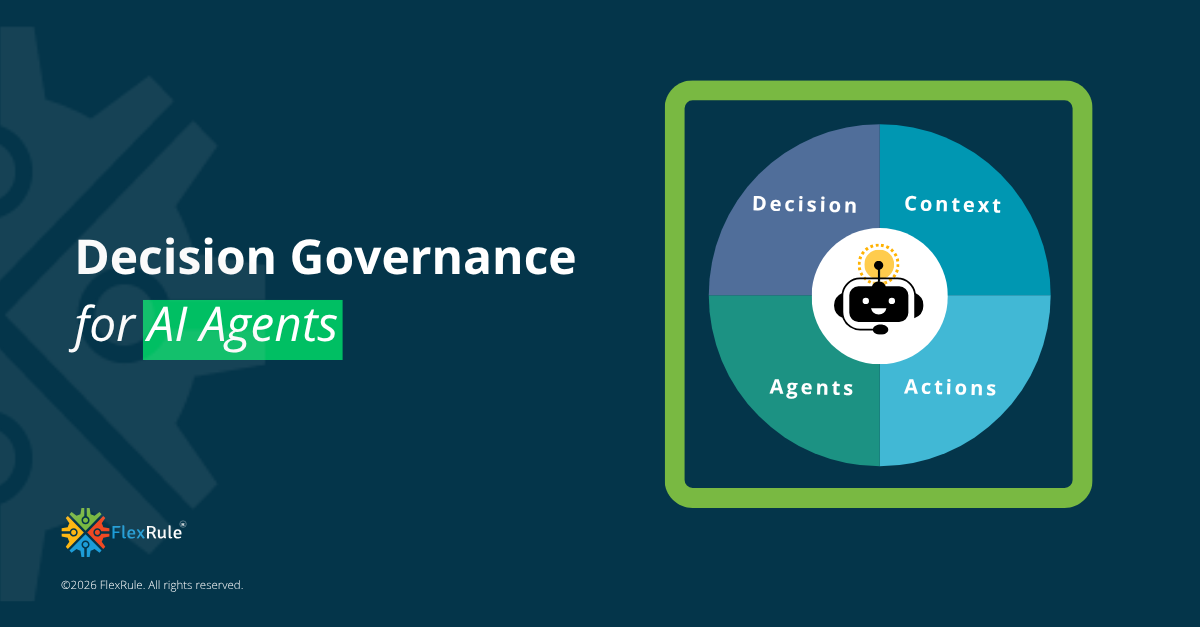
As a result, AI agent governance must cover ALL 4 layers: Decisions, Contexts, Actions and Agents

Layer 1 – Govern Decisions
AI agents should not make decisions. They should inform standard-based and explicit decision model (DMN Conformance Level 3) for execution. The decision logic is human-readable, portable and auditable. Not a black box. A regulator can read it. An auditor can validate it. Machine and AI can execute with consistency.
Action Determination and Recommendation Decisions
AI agents evaluate conditions and inform what action should be taken next. The decision model governs the output, not the agent.

Rights and Admissibility Decisions
Every agent action passes a runtime gate that determines what is permitted under current context and policy. No execution proceeds without an explicit admissibility decision.

Operational and Tactical Decisions
Decisions that govern day-to-day execution across processes, systems, and actors are modeled explicitly and versioned. Logic is auditable at every stage, not buried in code or configuration.
DMN Decision Table — Claims Admissibility
| Claim Amount | Evidence | Fraud Flag | Outcome |
|---|---|---|---|
| any | any | true | Halt |
| > 2000 | missing | false | Halt |
| > 2000 | pending | false | Defer |
| > 2000 | verified | false | Allow |
| ≤ 2000 | any | false | Allow |
DMN CL3 · Direct execution · No compilation layer
Layer 2 – Govern Contexts
Governing decisions, actions, and agents means nothing if the information driving them is ungoverned. LiveContext is the reusable, governed semantic layer that assembles decision-ready context from any data source — consistent, versioned, and fully traceable across every layer.

Single source of truth — consistent across every layer
All context defined once in a governed semantic model. No scattered pipelines, no ad-hoc queries. The same governed context feeds Layer 1 decisions, Layer 2 admissibility, and Layer 3 agent execution.

Fact Concepts and Role Relations — business-centric semantics
Context modelled as governed business entities with explicit relationships. Decouple decision logic from the physical data layer — change the database without breaking decisions or agents.

Full context lineage — from source to outcome
Every context attribute traced to every decision and agent action that consumed it. Satisfies DORA auditability and EU AI Act Article 13 explainability requirements at the context level.
LiveContext — Governed Semantic Layer
Fact Concepts
Business entities — Customer, Claim, Policy. Navigate context naturally, not raw tables.
Role Relations
Explicit governed relationships. Precise, automatic joins. No manual SQL.
Smart Queries
Declarative, push-down optimised. Same logic runs on-database or in-memory.
Context Lineage
Full dependency graph. Every attribute traced to every decision outcome.
Layer 1
Context layer surface allowing AI agents and systems access data via standardized expression
Layer 2
Logical view (semantic, relations and transformation) and governance across multiple data sources
Layer 3
Physical data source connectors (database, files, documents, systems, API, …)
Fact Concepts · Role Relations · Smart Queries · Full lineage
Layer 3 – Govern Actions
At the commit moment within the boundary of execution the validity and eligibility of actions must be determined at runtime. The platform should enforce the validation gate within the workflow of the AI agents for their action points.
Admissibility — runtime enforcement
Admissibility modules evaluate AI agents at any stage and workflow level before execution. The process model has no knowledge of it. Admissibility modules must be managed separately to the process itself.

Admissibility as an Explicit Decision Model
Admissibility cannot be a static configuration. It is a business decision requirements and must be managed and maintained as a decision model using open standard with full runtime behavior.

Governance Team owned – Independent to AI workflow
The admissibility decisions must be owned, managed and enforced by the governance team, not by process modelers. They should be controlling AI agents at the higher level containing the execution boundary at runtime.
ADDMISSIBILITY ENFORCEMENT GATE
GATE 1
Activation — agent identity and role
GATE 2
Admissibility — case and context
Allow Stage activates. Execution proceeds normally.
Defer Stage blocked. CDM instance waits for next signal.
Halt Stage blocked. CDM instance terminated. Final.
Agent Identity, roles and permission, activation and runtime actions
Layer 4 – Govern Agents
AI agents are first-class governed actors in the platform. Each agent has an identity, governed access, and runtime admissibility applied to every action it takes.
Agent identity — accounts, keys, JWT claims
Agents are registered platform accounts with dedicated keys, JWT claims, groups, roles, and privileges. Same authorization model as users and service accounts. Gate 1 identity feeds Gate 2 admissibility.

Multi-provider — governance is provider-agnostic
Azure OpenAI, OpenAI, Anthropic Claude, Google Gemini, Amazon Bedrock, Ollama, and more. Governance applies regardless of provider. Switch providers without changing governance behaviour.

MCP tool registration — workflows as tools
Workflows and decisions registered as MCP tools. Agents invoke them via LLM native function calling for multi-actor environment coordination and collaboration.
ACTIONS – ACTIVATION AND TOOLS
⚡ assess_claimDecision
⚡ verify_identityDecision
⚡ send_communicationWorkflow
⚡ process_payoutWorkflow
⚡ escalate_for_reviewWorkflow
Event-driven and long-running orchestration activates an agent.
Agent reasons over available tools.
LLM function calling selects and invokes.
Admissibility governs every invocation.
Vendor agnostic . Long-running . Event-driven
Enterprise Decision Governance Layer
Control decision-making across AI, systems, and people.
Decision Asset Management
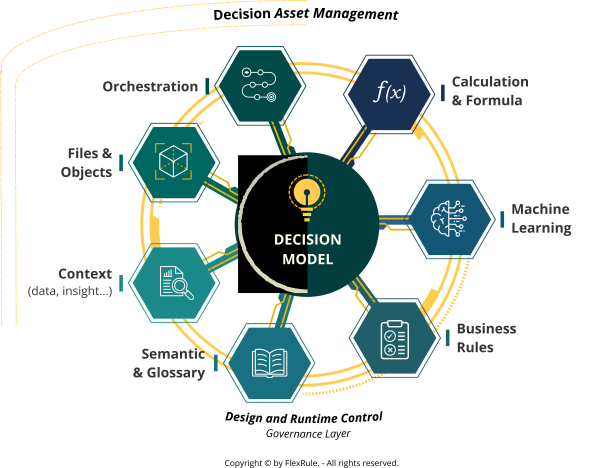
Decisions are first-class enterprise assets, both at design time and at run time. Decision Asset Management provides a dedicated governance layer to manage ownership, lifecycle, and change across all decision assets.
Decision assets include design-time artifacts such as files, documents, and executable logic, as well as runtime decision objects, configuration, settings, metrics and logs created and used during execution.
- Centralized repository for all decision assets across design, runtime and operation
- Clear ownership and responsibility boundaries
- Controlled evolution through versioning, review, and approval of all assets
- Traceability by managing linkage and lineage between design-time definitions and runtime behavior
- Manage business objects and lifecycles to long-running and continuous decisions
- Safe and secure promotion and evolution across environments
- Enables enterprise workflow and collaboration
This ensures decisions remain consistent, trusted, and governed from design through execution.

Make decisions explicit and understandable
Decision Governance requires clarity, not just control. FlexRule uses standards-based decision modeling (Decision Model and Notation, DMN with Conformance Level 3) to ensure decisions are both executable and understandable by humans, machines, and AI.
In many platforms, decision logic is transformed through multiple layers of compilation and abstraction. As a result, runtime behavior becomes detached from the original design, breaking traceability and undermining governance.
- Execution Fidelity: What you model is exactly what you execute. There are no black-box compilation layers to distort business intent.
- Standards-Based: Decision models defined using open standard Decision Model and Notation (DMN) with Conformance Level 3.
- Direct Execution: Human-readable logic is itself the executable artifact.
- Separation of Concerns: Clear separation of decisions from logic, data, and process.
- Full Traceability: Explainable outcomes where the runtime result traces directly back to the design intent.
Decisions are no longer hidden inside code, workflows, or opaque AI agents.
Govern what data decisions can see
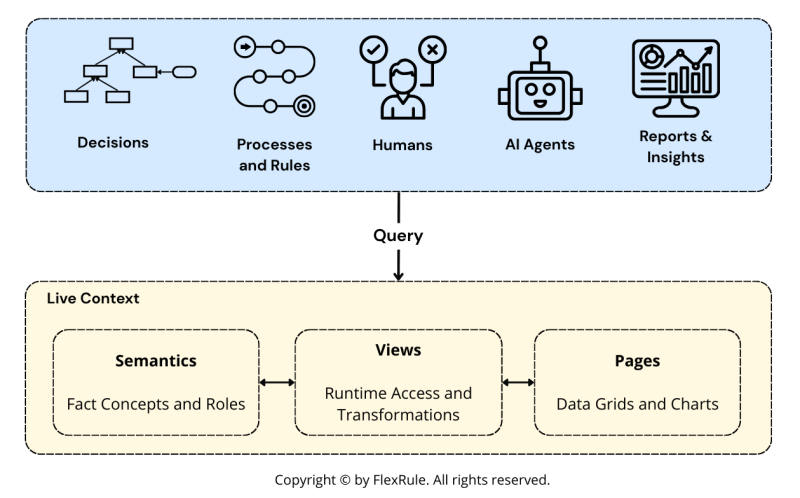
Decisions are only as trustworthy as the data they use. Decision Governance includes explicit governance of decision input context through LiveContext.
- Defined, decision-ready datasets as the context
- Controlled and structured access to decision inputs
- Consistent runtime context across executions
- Traceable data usage for audit and analysis
LiveContext ensures decisions operate on the right data, in the relevant situation, every time.

Adaptive decisions with feedback-loop and optimization
Continuous decisions progress through stages, spanning time and organizational boundaries. At each stage, actors operate with autonomy within defined governance guardrails, whether they are AI agents, local decision services, or human authorities.
A Continuous Decision Model (CDM) provides the opportunity to capture responses and operational signals at specific stages and use them as feedback to drive automated adaptive learning and continuous optimization of decisions.
Additionally, the CDM enables a long-running continuum of decision-making, comprised of a series of point-in-time decisions influencing each other over time. This ensures that within a governance layer, the enterprise controls the impact of downstream processes and systems.
Governance without centralization
Decision Governance does not mean centralizing decision execution or forcing all decisions into a single runtime or engine. FlexRule embeds governance across all phases of design, runtime execution, and operations of decisions.
Governance focuses on ownership, clarity, traceability, and controlled change, while execution remains distributed across systems, services, AI agents, and human actors.
This allows organizations to introduce strong governance without disrupting existing architectures or slowing down decision-making.
What this enables
- Govern decisions consistently across distributed and hybrid environments
- Maintain centralized visibility and control without creating runtime bottlenecks
- Allow decisions to execute where they are most effective, across systems, services, AI agents, and human actors
- Support multi-engine and multi-platform decision execution
- Scale governance independently of execution performance
- Preserve agility while enforcing accountability and compliance
In short, FlexRule governs what decisions are, how they change, and how they are explained, without dictating where or how they must run.


Learn more about Decision Governance
Decision Governance for AI Agents
Read More

What is Decision Debt?
Read More
Decision Governance for Autonomous Agents and AI
Read More
Deterministic AI That Is Adaptive, Explainable, and Context-Aware
Read More
Implementing AI Agent Governance Without an Engineering Overhaul
Read More
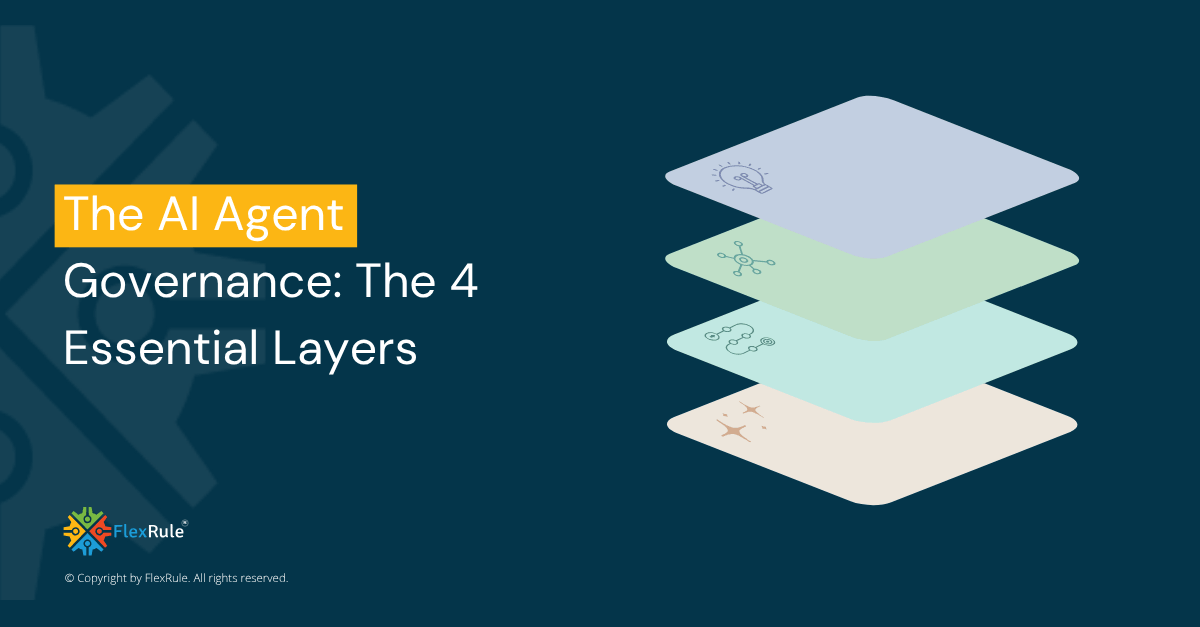
The AI Agent Governance: The 4 Essential Layers
Read More
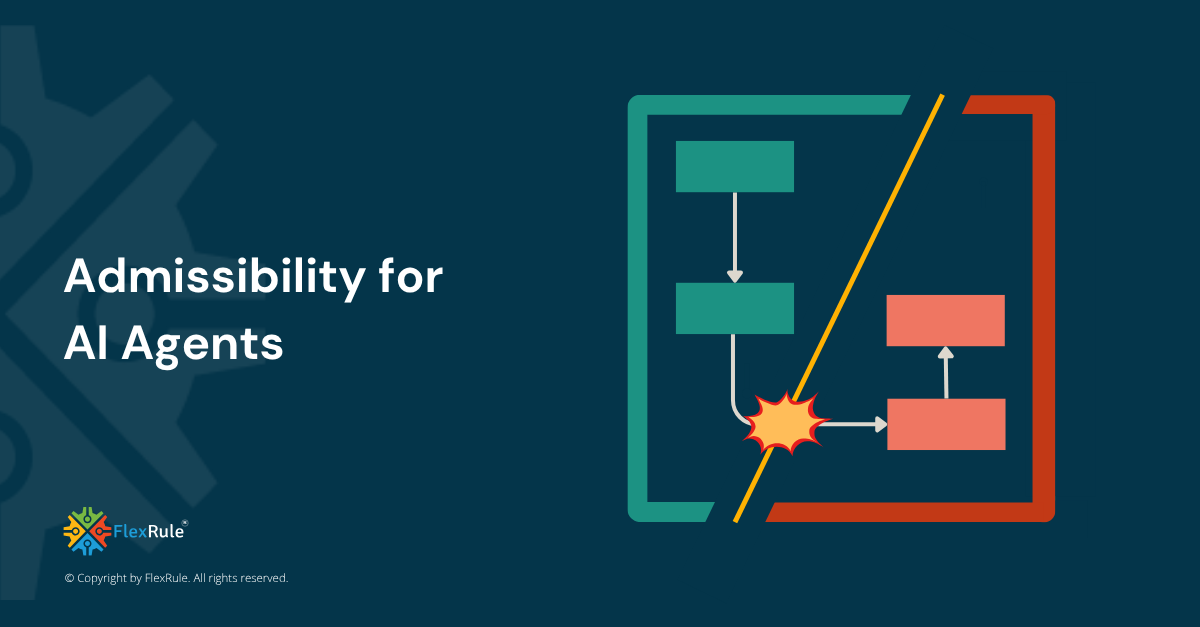
AI Agent Authorization and Control – Admissibility
Read More
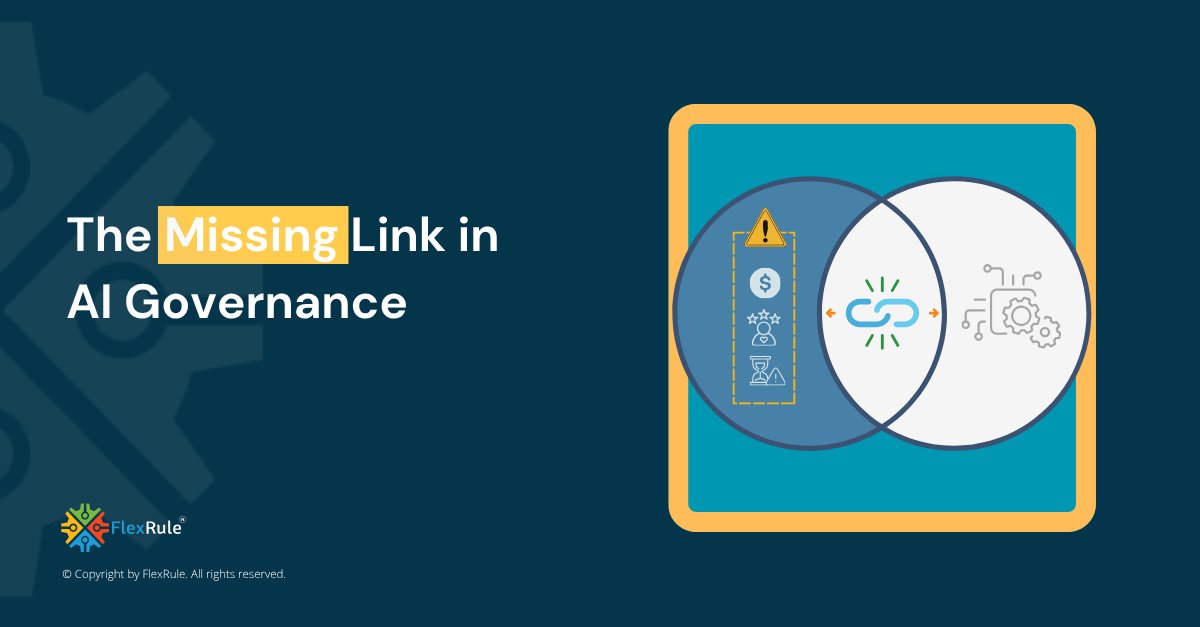
The Missing Link in AI Governance and Landscape
Read More