Operational Decisions meet Customer-facing channels
There are hundreds of thousands of decisions run every day in organizations. They put guardrails in place ensuring business operation is safe and effective.
These are called, operational business decisions. The day-to-day of business operation depending on them. Within this space of operational decisions, there are a special type that are operational but not only the owner of them is different but also, they are customer facing.
When operational decisions meet real time customer facing interactions, they get a new color and flavour.
While Next-Best-Action (NBA) originated in marketing and personalization, regulated industries are increasingly applying the same principles to operational decisions such as hardship handling, claims routing, fraud response, customer remediation, and collections intervention.
In these environments, every action must be contextual, governed, explainable, and traceable.
Back-Office Decisioning: The Core Business Operation
Every organization runs on back-office decisions. These are the operational decisions that keep the business correct, safe, and compliant.
- Should this loan be approved or declined?
- Is this claim valid?
- Should this transaction be flagged as fraud?
- Which supplier should fulfill this order?
These are deterministic, driven by organization policies and compliance, rule-heavy decisions.
They make sure the business runs fairly and consistently. Their impact on customer lifetime value (LTV) is indirect: by building trust, reliability, and fairness.
Front-Office Decisioning: Where NBA Lives
When operational decisions meet the customers wherever they are in real time, e.g. apps, websites, call centers, stores, and chatbots they take a new color and flavour. Not all customers care about compliance rules. But certainly all of them care about relevance, speed, and value in the moment.
This is front-office decisioning, powered by the NB* family:
- NBA (Next Best Action): What product, service, or action should we propose right now?
- NBC (Next Best Conversation): What should the bot or agent say next?
- NBO (Next Best Offer): What to offer to the client to increase the conversion?
- NBT (Next Best Treatment): What intervention will change an outcome (health, student success, customer retention)? Prescribes interventions in universities, schools, hospitals etc. to improve outcomes.
When people hear “Next Best Action (NBA)” or the broader NB* alphabet soup (NBA, NBX, NBC, NBT), they usually think about marketing add-ons or personalization tricks. But the reality is…
NBA is simply the framework for running front-office operational decisions applying to CX, marketing, and 1:1 personalization.
Think of NBA (Next Best Action) as the umbrella framework. It is the central idea that at any given moment there is one best decision for a specific customer in a specific context.
Back-office vs Front-office Operational Decisions
We have two diverse sets of operational decisions in any business operations. Let's put them side-by-side and understand how they stack up against each other.
Back-Office decisioning
- Purpose: Ensure business runs correctly, safely, and within policy.
- Nature: Deterministic, compliance- and rule-heavy, auditable.
- Examples: Credit approval, claims adjudication, fraud detection, pricing, access control.
- KPIs: Cost efficiency, compliance, SLA adherence, risk reduction.
- Impact on LTV: Indirect — builds trust, fairness, reliability so customers stay.
Front-office decisioning or NBA
- Purpose: Make interactions relevant, engaging, and valuable for the individual.
- Nature: Probabilistic, adaptive, context-driven.
- Examples: Upsell/cross-sell, retention offers, chatbot dialogues, proactive student support.
- KPIs: Conversion, engagement, retention, NPS, LTV growth.
- Impact on LTV: Direct — increases engagement, spend, advocacy.
So, if we compile the comparison table we can see clearly, they are similarities and differences between these two groups.
| Dimension | Operational Decisions | NB* |
|---|---|---|
| Goal | Correctness, compliance, risk control | Personalization, engagement, relevance |
| Nature | Deterministic, rule-based | Probabilistic, AI-driven |
| Latency | Can tolerate micro-delays | Must be real-time (moment of interaction) |
| Ownership | Risk, operations, compliance | Marketing, CX, customer service |
| Impact on LTV | Indirect (trust & fairness) | Direct (growth & engagement) |
Data and Analytics Lens
If we think about it from the data and analytics action framework:
Then the NBA tries to close the gap between insight-to-action by leveraging the concept of “best decision” and put operational decisions directly in front of the customers and consumers in the moment across multiple channels.
Where the Line Is – How are they compared?
As we established when the operational decisions are applied on the customer -facing scenarios for CX, 1:1 personalization and engagement in real-time they are using a framework named Next best action or NBA decisioning.
Although one can say the line between them is the validity, but in many cases NB* must provide compliant advice, conversations and offer, so still validity matters in front-office (NBA) decisions.
1. Purpose
- Back-office decisions: Ensure the business runs correctly, safely, within policy.
- “Is this transaction valid?”
- “What price, risk, or route is compliant?”
- Front-office decisions: Maximize customer relevance and value at the touchpoint in real time.
- “What’s the best offer, response, or experience for this individual right now?”
Line: One enforces validity; the other optimizes for value.
2. Nature of Decision
- Back-office decisions: Deterministic, constrained, explainable, policy-driven.
- Binary/limited outcomes (approve/deny, route A vs B).
- Front-office decisions: Probabilistic, adaptive, exploratory.
- Ranking or selection among many options (offer X, offer Y, do nothing).
Line: If the wrong decision breaks rules, it’s operational. If it misses opportunity, it’s NB*.
3. Ownership
- Back-office decisions: Risk, compliance, finance, operations, SMEs.
- Front-office decisions: Marketing, customer service, growth, CX.
Line: Who “signs off” — regulators & auditors vs marketing/CX leads.
4. Latency & Context
- Back-office decisions: May be real time, but mostly correctness > speed (fraud check, claims validation).
- Front-office decisions: Must be real time, at the edge (click, call, checkout, chat).
Line: Operational tolerates micro-delays; NB* dies if it misses the moment.
5. KPIs
- Back-office decisions: Cost, risk exposure, compliance, SLA adherence.
- Front-office decisions: Conversion, engagement, NPS, retention, LTV growth.
Line: Auditability vs personalization lift.
How They Work Together
From the operation and the value organization need to deliver, these two types must work together. Although we separate them to make it easier to understand and manage, but they both are related. Both belong to organizations that they care about customer-centricity.
- Operational (back-office decisions):
- Gatekeepers.
- Define what is valid, safe, and compliant.
- Examples: “Is this claim valid?”, “Is this transaction fraudulent?”, “What’s the best price or rate?”
- NBA (front-office decisions):
- Optimizers.
- Among the valid options, choose the one that maximizes value and relevance.
- Examples: “What’s the best upsell here?”, “What response should the agent give?”, “Which experience keeps the customer engaged?”
Where NBX Fits
Think of NBX (Next Best Experience) as the bridge layer between the two:
- It consumes outputs from operational decisions.
- Example: Fraud check says transaction is valid.
- Pricing engine says eligible for 7% rate.
- Claims adjudication says claim is payable.
- It feeds those valid outputs into personalization orchestration. Now NBX decides:
- “How do we sequence the experience of informing the customer?”
- “Do we wrap this with loyalty rewards, education, or proactive support?”
- “What’s the journey across email, app, and call center?”
- It ensures consistency across both worlds.
- Customers get only safe, compliant options.
- But they experience them as engaging, personalized journeys.
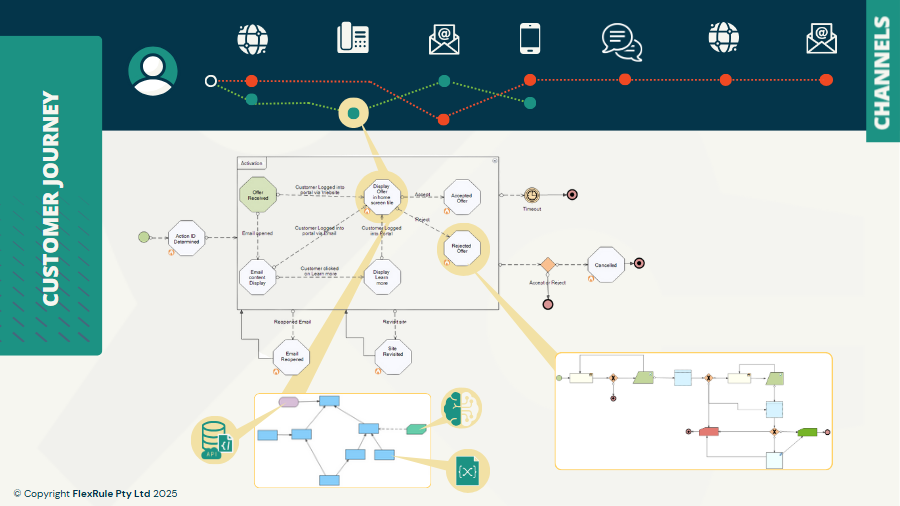
In the below example, as customer journey goes through different touch points, there are different processes to be kicked off, and different decision models to be execyuted and governed by a model that captures the feedback and ensures relevancy to the customer engagement.
The Role of NBA in Real-Time Decisioning & Personalization
NBA (Next Best Action) is the operational framework for operationalizing the front-office decisions.
It acts as the distributed nervous system that sense the customer behaviors, determine the best decision fior that moment and provides the customer the best “thing” that fulfils their desire and objectives.
“What should we as the company do right now for this specific client, in this specific moment in this particular channel in this engagement?”
Core Roles of Next Best Action Decisioning
- Best Decision: The only decision model in the moment that is relevant to customer to increase the LTV.
- Decision Orchestration: Balance customer signals (behavior, preferences, risk) with business priorities (profit, compliance).
- 1:1 Personalization: Individualize actions, not just segment-level marketing product push. NBA shifts from segment-based campaigns (“people like you”) to true individualization (“you”).
- Conflict Resolution: Resolve competing goals across departments. For example, Marketing wants to upsell while, Service wants to resolve issues quickly.
- Learning & Adaptation: Feed outcomes back into models for sharper personalization. It learns from every single customer interaction unlike static rule-based decisions in risk or compliance.
Next Best Action (NBA) and Decision Modeling
NBA decisions (NBA, NBX, NBM, NBC, NBT) are still a type of operational decisioning, but they are front-office, customer-facing decisions in real time.
That means the Decision-Centric Approach® still applies. We need to model the best decisions across the customer journey. Without decision modeling, NBA quickly turns into a tangled mess of scores, rules, and data. It becomes a spaghetti bowl that is impossible to maintain, update, or scale.
In fact, NBA is where proper decision modeling becomes even more critical:
- Organizations often have dozens of NBA initiatives running at the same time, each being added and expanded constantly.
- NBA decisions span multiple dimensions such as regulatory constraints, customer preferences, channel engagement, and operational feasibility.
Therefore, NBA requires a multidisciplinary, multi-dimensional model so every team member can see their piece in context, understand how it fits, and collaborate and participate without silos.
Decision modeling brings two essentials:
- Clarity at design time: Everyone knows exactly what their pieces of the puzzle are for the “best decision” being made. They are clear about the best choices for that specific moment, what factors matter, and how everything fits together in operation.
- Transparency at execution time: The system can explain why a particular option was selected as the best in that exact moment for the customer.
- Alignment across teams: NBA decisions span marketing, service, compliance, and operations. Decision modeling creates a common language, so all stakeholders are aligned on what is the “best decision” means, balancing customer relevance with business priorities.
NBA without decision modeling is fragile and opaque. NBA with decision modeling is scalable, explainable, and trustworthy.
Book a Custom Demo
Critical Requirement for Next Best Action (NBA) Decisioning
The decision modeling is at the heart as they are based on operational decisions but the one driving the customer engagement and 1:1 personalization. But beyond decision modeling, running NBAs require more muscle than operationalizing back-office decisions.
Volume and velocity
NBA is not a once-in-a-day or once-in-a-transaction decision. It happens continuously, across thousands or millions of micro-interactions every day. That means a massive scale of events firing constantly.
Dynamic context assembly
Back-office decisions often rely on structured, stable data (policy record, application form, transaction). But the NBA must pull together decision-ready context dynamically from multiple systems in real time: behavioral signals, preferences, risk scores, engagement history, product catalogs, compliance constraints, etc.
Continuous and Adaptive learning
Back-office rules may change quarterly or annually with policy updates. Their decisions are largely deterministic and compliance heavy. But NBA needs to learn and adapt constantly, feeding outcomes back into models so it gets smarter over time. It requires AI/ML to rank and adapt choices uniquely per individual, balancing personalization with business priorities. It continuously refining what the “best decision” is for each moment and each customer.
Event-driven orchestration
Back-office processes are usually prescriptive. But customer’s journeys are non-linear and stateful and they vary so cannot be prescribed based on a process. Customers switch channels, abandon carts, re-engage later, or move between service and sales. NBA needs adaptive and event-driven orchestration that can pause, resume, and adapt mid-journey.
Real-time requirements
Back-office decisions (like claims adjudication or credit approval) can run in seconds or even minutes. But NBA must execute in milliseconds, right at the moment of interaction (click, call, chat, checkout). The tolerance for delay is near zero.
Where the Line Disappears: Regulated Service Operations
In regulated service operations, the clean separation between back-office and front-office decisioning breaks down. A hardship assessment is a front-office interaction that is also a back-office obligation. It is real-time and contextual and customer-facing. It is also regulatory, auditable, and compliance-driven. Both at the same time.
The same applies to claims routing, vulnerability determination, collections holds, fraud response, and customer remediation pathways. Each is an NBA decision. Each is contextual, situation-aware, and time-sensitive. Each also requires an audit trail, carries regulatory obligation, must be consistent across every agent and every channel, and must be explainable when the regulator asks why.
Neither back-office governance alone nor front-office NBA alone is sufficient for this class of decision. This is where decision-centric NBA, applied with governance as a structural design requirement rather than an afterthought, becomes Governed NBA. Not a separate concept. The natural extension of everything this article describes, applied to the decisions where the engagement layer and the governance layer converge.
Final Thoughts
Next Best Action pushed the boundary of marketing. It moved organisations from segment-based campaigns to real-time, 1:1 personalisation at the engagement layer. From static schedules to individual context. From batch decisions to live, adaptive, situation-aware interactions. That was a genuine and significant advance.
But the real value of NBA is realised when it reaches beyond marketing operations entirely. When the same concept — the right action, for the right customer, at the right moment — is applied to the decisions that actually determine regulatory standing, customer outcomes, and organisational risk. Hardship treatment. Claims routing. Vulnerability handling. Collections strategy. Remediation.
That is where NBA stops being a marketing tool and becomes an operational governance capability.
Welcome to Decision-Centric NBA, That is Governed NBA.
Read More

Last updated May 15th, 2026 at 09:40 am Published August 19th, 2025 at 08:47 am